
Sex Offender Checks in Hidalgo County
The Texas Public Sex Offender Registry is the first official channel for a Hidalgo County sex offender search. Texas DPS manages the system under Code of Criminal Procedure Chapter 62. Local police departments register people who live within their cities. The Hidalgo County Sheriff handles registration outside incorporated municipalities. That division tells a reader which local agency can check a suspected error or possible failure to report.
A registry result should be read as a public-safety record, not as a complete criminal history. The public listing is built from a specific registration duty. It does not replace the court file, and it does not prove that a person with a similar name is the registrant. Use the full official listing, compare more than one identifier, and contact the responsible registering agency when a material point seems wrong.
Hidalgo County Registry Search Layers
Texas DPS and the federal government provide two official search layers. DPS is the direct source for Texas registration data. The Dru Sjodin National Sex Offender Public Website, or NSOPW, searches participating state, territorial, and tribal registries at once. That wider view helps when a person may have moved across a state line, but the underlying Texas entry still comes from the Texas system.
The official NSOPW search is shown below because it is the cross-state fallback assigned to this Hidalgo County registry page.
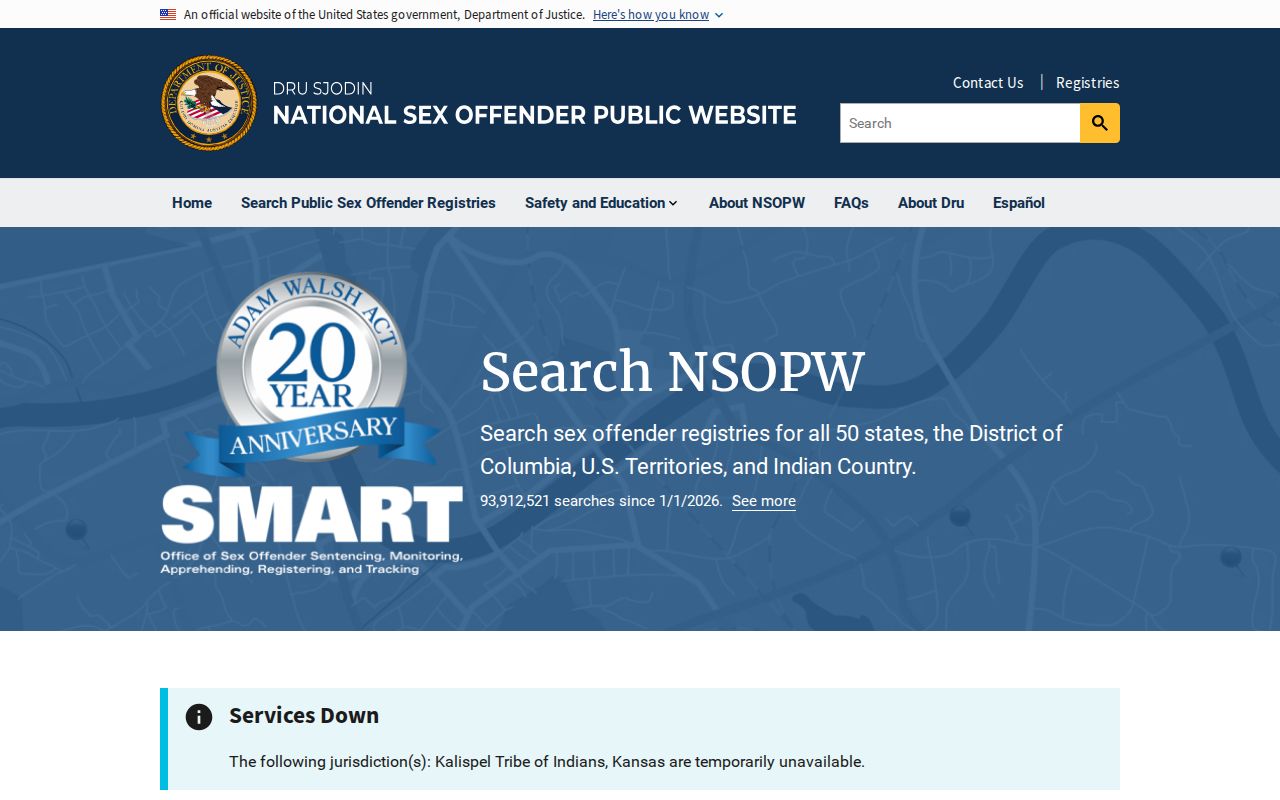
Use the Texas listing for state details, then use NSOPW to check whether another jurisdiction has a relevant public entry.
How to Search the Texas Public Sex Offender Registry
The Texas registry is interactive, and it timed out during the official research inspection. Its current field labels, radius choices, buttons, map controls, and result layout could not be verified. A safe search process therefore follows what the live government site actually displays instead of assuming that common registry controls exist.
- Open the official Texas DPS registry and read its current notice and conditions before searching.
- Use only the search choices that the live registry presents. Do not assume a county, ZIP, map, or radius option is available until it appears there.
- Compare the returned public details carefully. A name and date of birth are not fingerprint proof of identity.
- Open the relevant public entry, note its registering authority, and contact that city police department or the Hidalgo County Sheriff about a suspected error.
The verified search-field inventory is deliberately limited:
| Search Element | Verified Status | How to Proceed |
|---|---|---|
| Field labels | Not captured | Use the labels shown on the live DPS page |
| Map or radius tools | Not captured | Do not assume a distance choice exists |
| Result and profile controls | Not captured | Follow the current official interface |
| Cross-state search | Verified | Use the official NSOPW system |
The assigned capture from the Texas DPS registry identifies the proper official starting point.
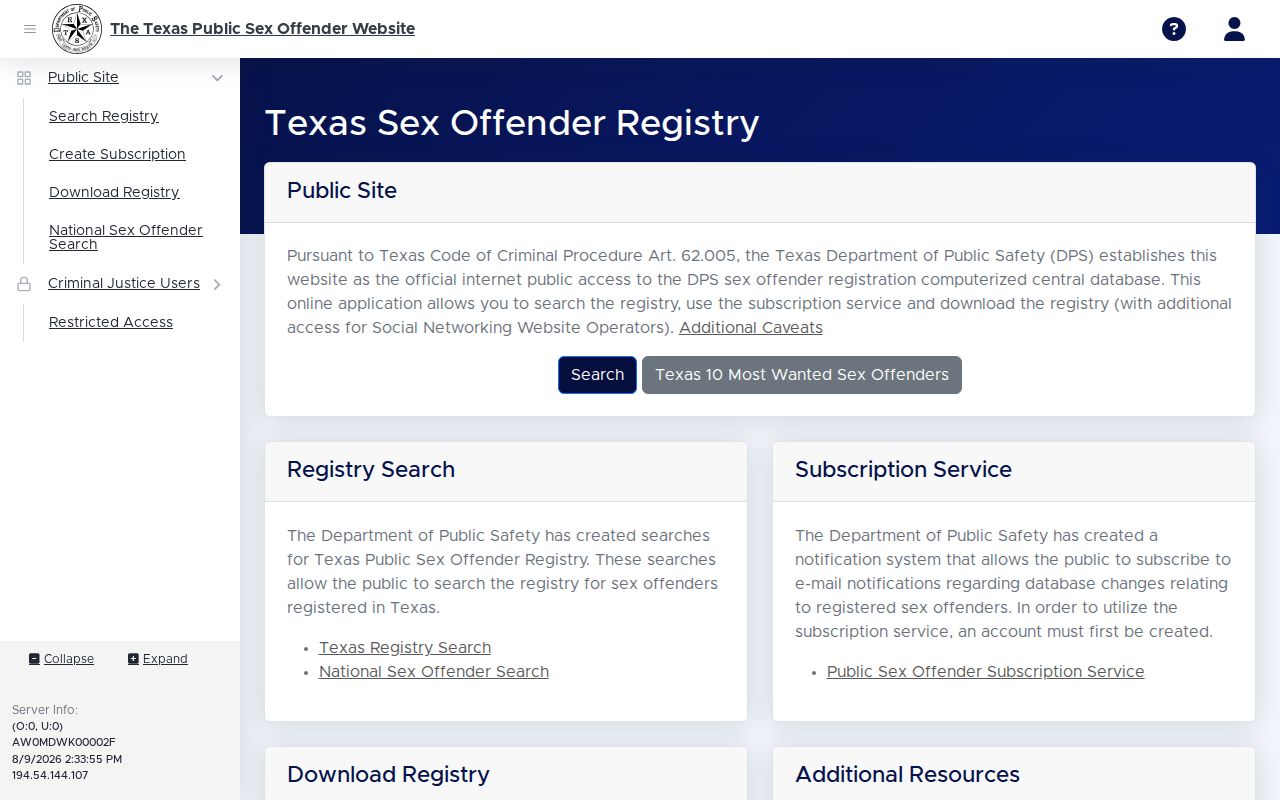
Recheck the live controls each time because the research did not establish a fixed field set or screen layout.
Note: A blank search does not prove that no duty exists, and a similar name does not establish identity without fingerprints.
Inside a Registry Profile
Chapter 62 identifies data collected for the Texas Sex Offender Registration Program, but collection does not mean every item is public. Because the live profile could not be inspected, the table separates statutory categories from explicit public exclusions. It does not claim that each collected field appears on every current Hidalgo County registry profile.
| Identity and description | Name, aliases, date of birth, sex, race, height, weight, eye and hair details, photo, and fingerprints are collected. |
|---|---|
| Residence information | Address or geographic residence information is collected for registration and public-safety administration. |
| Case and status data | Offense, victim age, conviction date, punishment, and custody or supervision information are collected. |
| Other collected data | Professional credential, higher-education affiliation, phones, online identifiers, and specified vehicle information fall within the statutory inventory. |
| Public exclusions | Social Security and driver-license numbers, phones, online identifiers, employer contact, victim-identifying information, DPS-only additions, and nonpublic juvenile information are excluded. |
A public omission can be required by law. It is not proof that the registering agency failed to collect the information.
Hidalgo Registry Data Boundaries
The line between collected data and public data protects victims, juveniles, and sensitive identifiers. Phones and online identifiers can help law enforcement monitor a registration duty, yet Chapter 62 excludes them from public display. Employer contact and victim-identifying information are also withheld. A private searcher should not try to reconstruct those withheld fields from other sources.
The official DPS registration FAQ supplies the program context used for this Hidalgo County sex offender search.
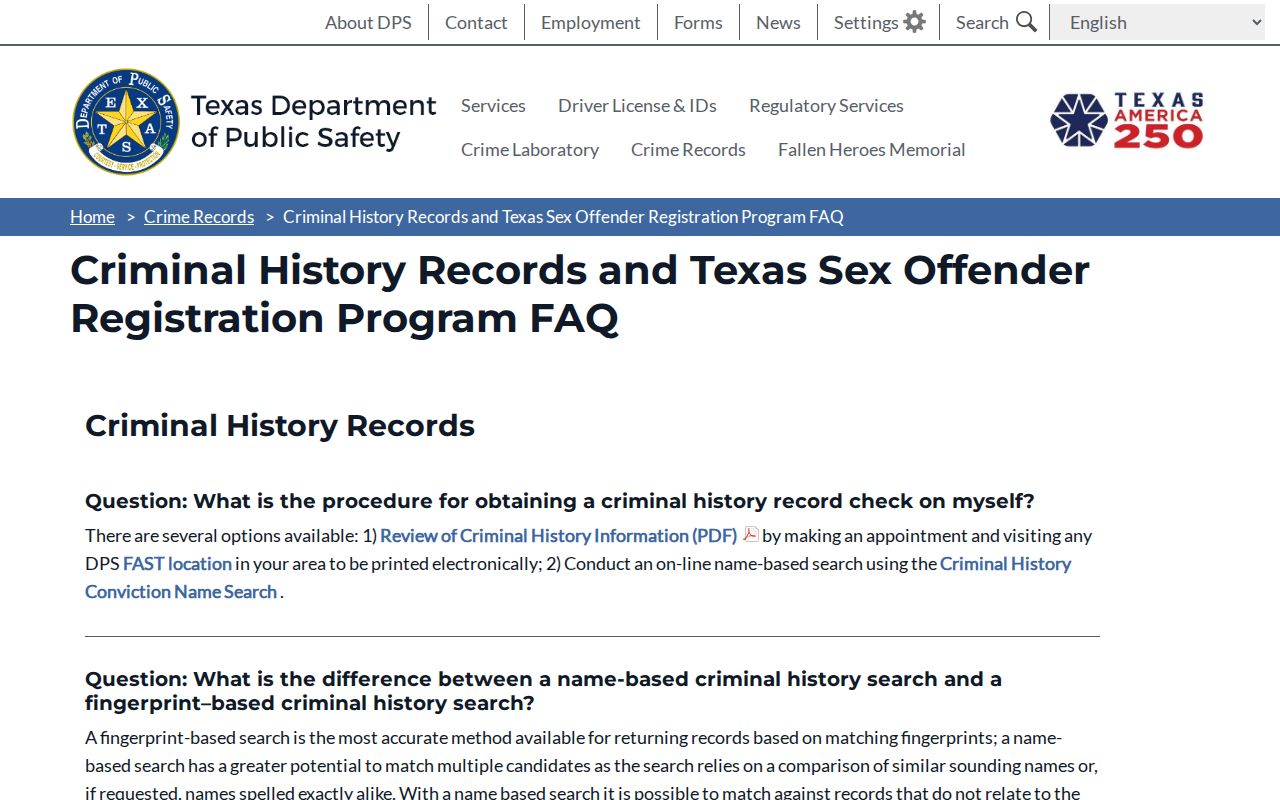
The FAQ helps explain duties and classifications, while the live registry remains the official place to review a current public listing.
Hidalgo County Registry Verification Cycles
Verification is the required contact between a registrant and the responsible local authority. The ordinary Chapter 62 schedule is annual. A person with two or more sexually violent offenses verifies every 90 days, while a person under civil commitment verifies every 30 days. These intervals describe the duty to report. They do not promise that a public screen refreshes at the same moment an agency receives information.
Changes in residence, identity details, higher-education affiliation, or other reportable facts follow Chapter 62 rules. Within McAllen, Edinburg, Mission, or another municipality, the city police department is the local contact. For an unincorporated Hidalgo County residence, the sheriff is the contact. A reader who sees a possible mismatch should save the official public entry, note the concrete concern, and report it to that authority. The agency can check its registration file and decide whether the public information needs correction.
Note: Verification frequency comes from statutory status, not from the Level 1, 2, or 3 risk label by itself.
Texas Registration Levels and Requirements
Texas uses numeric risk levels. They are not the same as federal SORNA tiers. Level describes the assessed danger and likelihood of continued criminal sexual conduct. Duration is a separate question tied to the exact Chapter 62 offense and case. An adult duty lasts either ten years after the latest discharge, release, or dismissal, or for life. Juvenile duration is generally ten years under the provisions summarized by DPS.
| Classification | Meaning | Duration or Check-In Rule |
|---|---|---|
| Level 1, low | Low danger and not likely to continue criminal sexual conduct | Duration depends on the offense; ordinary verification is annual |
| Level 2, moderate | Moderate danger and may continue | Duration depends on the offense; ordinary verification is annual |
| Level 3, high | Serious danger and expected to continue | Duration depends on the offense; notification rules are broader |
| Two or more sexually violent offenses | Frequency category set by Chapter 62 | Verification every 90 days |
| Civil commitment | Court-identified sexually violent predator under intensive supervision and treatment | Verification every 30 days |
Level 3 and civil commitment notification can include English and Spanish DPS postcards sent to the immediate community. The exact offense, not the level label alone, controls whether the duty is ten years or life.
Hidalgo County Residency Rule Limits
Chapter 62 does not create one universal Texas distance from every school or park. A court supervision condition can impose a location restriction, and a municipality may have a separate rule. Those sources must be checked for the person and place at issue. A broad statement that all registrants face one statewide distance would be inaccurate.
Registry address information supports awareness. It does not authorize entry onto property, surveillance, threats, or direct enforcement. When a location raises a real compliance concern, give the facts to the proper city police department or the Hidalgo County Sheriff and allow the agency to review them.
Note: A registry map or address should never be treated as a substitute for the terms of a court order or city ordinance.
Community Notification and Lawful Use
Community notification is meant to help residents make sound safety plans. Texas uses risk, duty, and location rules to decide what is released and when direct notice occurs. Public records should be checked against the current official profile. Suspected noncompliance belongs with law enforcement, not with a neighborhood confrontation.
Use registry data lawfully: Code of Criminal Procedure Chapter 62 establishes the registration, public-data, verification, and notification framework for public protection. Do not use a Hidalgo County registry entry to harass, threaten, intimidate, discriminate, or take vigilante action against a registrant or anyone in the household.
A registry entry can change as the responsible authority receives and checks new facts. Confirm a current public record with DPS or the registering agency before making any safety decision based on it.