
Hidalgo County Criminal Court Cases
Hidalgo County divides criminal cases by offense level. District courts hear felony prosecutions. County Courts at Law have original jurisdiction over Class A and B misdemeanors, plus appeals from lower courts. The County Clerk Criminal Department supports County Courts at Law 1, 2, and 4 through 10. Municipal and justice courts retain fine-only matters within their authority. That split determines which clerk has the complaint or indictment, docket entries, orders, and final judgment.
The clerk is the custodian, not merely a search service. A county portal result can help identify a cause number and court, but the County Clerk supplies official misdemeanor material and the District Clerk supplies felony documents. City or justice-court records must be requested from that lower court. Start with the offense level and court shown on the docket before asking for copies. This avoids sending a felony request to the County Clerk or treating a municipal citation as a county criminal prosecution.
Hidalgo Criminal Case Clerk Split
The Hidalgo County Clerk Criminal Department handles misdemeanor court records, arraignment notices, NISI matters, and bond-forfeiture work. Its public counter is in the Hidalgo County Courthouse at 100 N. Closner Boulevard in Edinburg. The office can be reached at 956-318-2100 or 956-318-2811. Mail for this department goes to P.O. Box 58, Edinburg, Texas 78539.
The Hidalgo County District Clerk keeps felony district-court files, appeals, and related records. Its main line is 956-318-2200, and its mailing address is P.O. Box 87, Edinburg, Texas 78539. A requester who knows only a name should ask which court owns the cause before ordering a certified disposition. That one document often gives the clearest proof of the filed charge and final result.
The county's official Criminal Department page shows where the misdemeanor record route begins.
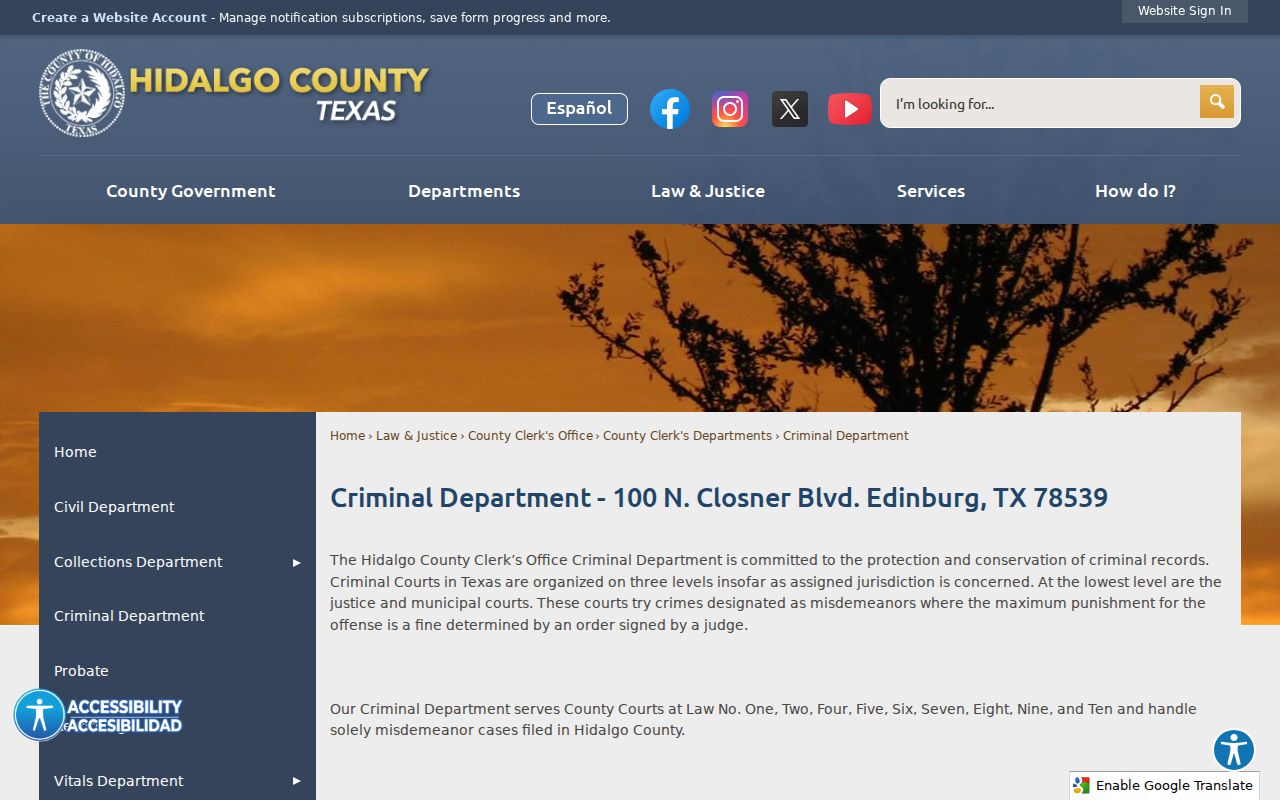
The image reinforces the local clerk split: county-level misdemeanors are not held by the felony clerk or a city police department.
Searching Hidalgo County Case Records
The county's Civil and Criminal Case Search gateway leads to the shared Case & Jail Records interface. The District Clerk says a case number is the best key. If it is unavailable, combine the person's name with date of birth. Not every Hidalgo County criminal case is online, and documents shown there are informational rather than certified.
- Open the county gateway and choose the criminal mode rather than civil.
- Enter the case number when known, since the official instructions call it the best search key.
- When no cause number is available, use the name and date of birth to narrow similar names.
- Identify the court and clerk from the result, then read the docket as an unofficial case summary.
- Request an official or certified document from the County Clerk, District Clerk, or lower court that holds the file.
| Field Label | Type | Required | Notes |
|---|---|---|---|
| Civil / Criminal mode | Selector | Yes | Choose criminal for a prosecution search. |
| Case Number | Text | No | The official guide identifies this as the best search. |
| Name | Text | No | Use with date of birth when the case number is unknown. |
| Date of Birth | Date or text | No | Helps narrow a common-name match. |
The live portal could not be inspected beyond these verified controls. Result statuses, attachments, financial fields, redactions, and document charges should be confirmed on the current screen or with the clerk rather than assumed from another county's system.
Hidalgo Court Portal Limits
The Hidalgo Case & Jail Records Search is a useful index, but it is not the final authority. The live system could not be fully inspected because of a redirect loop. Result fields, status labels, document downloads, date coverage, fees, sorting, and redaction behavior therefore should not be assumed. A blank result can mean the case is older, stored, held by another court, restricted, or simply outside the online collection.
If a felony file is stored, the District Clerk says in-person copies can often be supplied the same day, but at least 24 hours may be needed to retrieve older storage material. Email and mail copy instructions are available through the clerk. Ask for a certified copy when proof of the disposition is needed. Portal pages do not become official merely because they display a county case number.
Note: A name and birth date narrow a search, but only fingerprints positively establish identity in a statewide criminal-history record.
Inside a Hidalgo County Case File
A Hidalgo County criminal case file follows one prosecution. It differs from an arrest report, which describes the law-enforcement event, and from the DPS history, which compiles reportable statewide cycles. The court file may include the charging instrument, pleas, motions, hearing activity, orders, judgment, sentence, bond material, and financial entries. Exact online fields were not verified, so the clerk's actual file controls.
| Case Number & Court | Identifies the cause and the Hidalgo court responsible for the prosecution. |
|---|---|
| Charging Document | A complaint, information, or returned indictment states the charge filed in court. |
| Docket Entries | Chronological entries mark filings, settings, motions, orders, and other case events. |
| Hearing Dates | Settings show scheduled court activity but do not alone establish the outcome. |
| Disposition & Judgment | Shows whether a charge ended in conviction, dismissal, acquittal, or another recorded result. |
| Sentence & Conditions | Records punishment and any court-ordered custody or community-supervision terms. |
Grand-jury proceedings are secret even though a returned indictment ordinarily enters the court file. Juvenile material, protected victim information, sealed matters, expunged records, and nondisclosed information can also be restricted. A missing document may reflect a lawful limit rather than a search failure.
Hidalgo Criminal Docket Terms
Several short terms carry important meaning in Hidalgo County court records. They should be read with the full docket and disposition, not as stand-alone proof of a final result.
- Information
- A prosecutor-filed charging instrument commonly used for a misdemeanor.
- Indictment
- A grand jury's true-bill charging instrument for a felony.
- Disposition
- The recorded outcome or status that resolves a charge.
- NISI
- An initial bond-forfeiture judgment after a failure to appear, maintained locally by the County Clerk.
- Deferred adjudication
- A court defers a finding of guilt while imposing community supervision; Texas includes it in the public DPS product.
A dismissal ends a charge without a conviction, but it does not automatically erase the arrest or every linked record. Expunction under Texas Code of Criminal Procedure Chapter 55A and an order of nondisclosure under Government Code Chapter 411 are separate forms of relief with distinct eligibility rules.
How a Criminal Case Moves
The filed case starts after law enforcement and prosecutors have created earlier records. A booked allegation can change when the prosecutor files an information or presents a felony to a grand jury. Motions, pleas, trial decisions, and sentencing then add events to the clerk's file. This is why a reader should compare the initial booking charge with the charging document and final judgment.
Case flow: Charges Filed → Arraignment → Pretrial → Plea or Trial → Disposition → Sentencing
An arraignment addresses the charge and plea. Pretrial work can include motions, hearings, negotiations, or case settings. A plea or trial leads toward a disposition, while sentencing records the punishment after adjudication. Appeals create another layer of court records. The exact pace depends on the case, and no Hidalgo timeline should be inferred from one online docket entry.
Hidalgo Criminal Records Courthouse
County and District Clerk functions moved into the new Hidalgo County Courthouse at 100 N. Closner Boulevard in 2025. The official county budget describes a seven-story building of about 344,000 square feet with 31 courtrooms, more public space, and updated access and security. That move matters when old instructions refer to an annex, an obsolete floor, or the former 1954 courthouse.
The official Hidalgo Case & Jail Records Search provides the visual entry to Hidalgo criminal case and jail records.
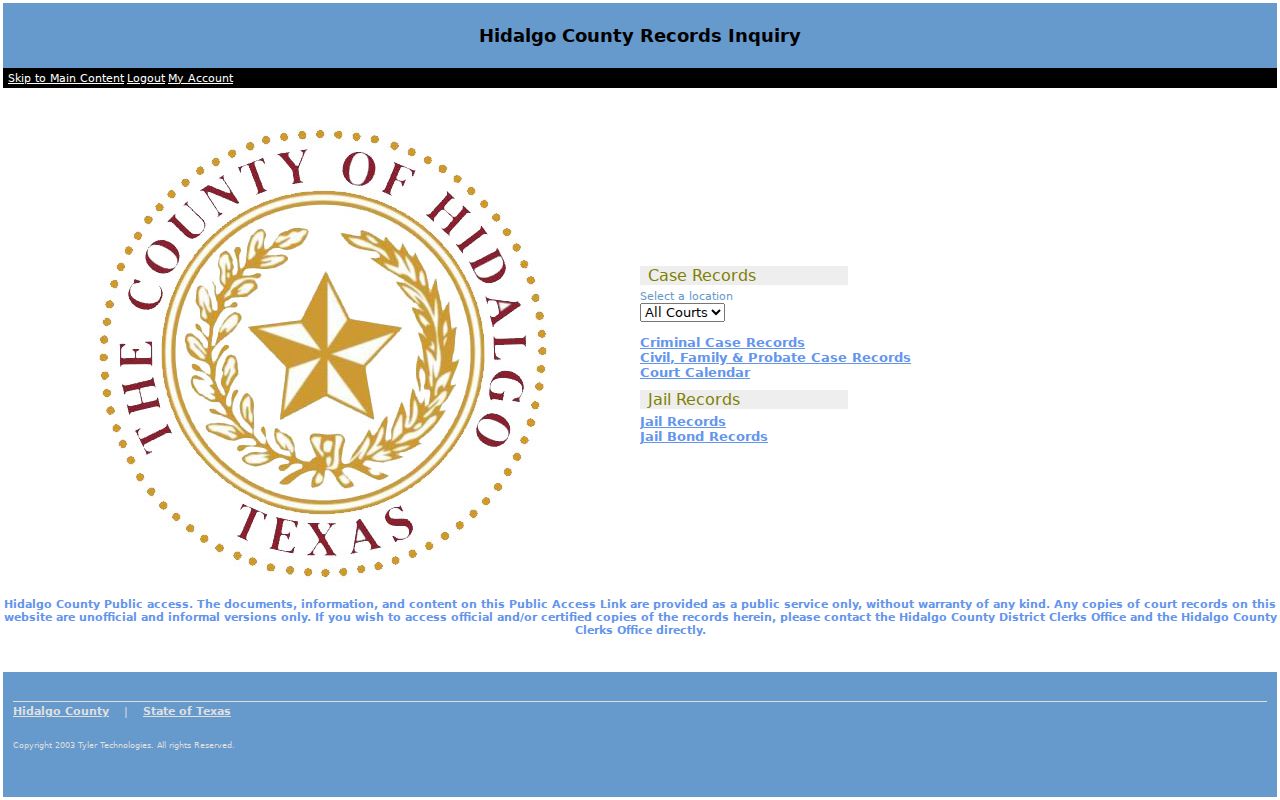
The shared interface helps locate a cause, while the new courthouse counters remain the place to identify the right clerk and obtain an official copy.
Visitors pass through security screening, and courtroom rules can restrict phones, recording, bags, food, and other items. Confirm the exact courtroom or floor through the current court page before traveling because thirteen district courts have separate direct lines and assignments can change.
Case Record Access & Restrictions
Texas law does not make every part of every Hidalgo County criminal file public. The Texas Public Information Act governs requests for government records, but court access also depends on the record and judicial rules. Juvenile cases, grand-jury material, protected victim data, sealed warrants, expunged files, and nondisclosed information may be withheld or restricted. Online summaries can also contain fewer details than the clerk's paper or electronic file.
A written request should seek existing records rather than ask the office to research a legal question or create a new report. Name the cause number, court, document, and date range when possible. For a felony, use the District Clerk. For a Class A or B misdemeanor, use the County Clerk. For fine-only matters, contact the municipal or justice court. When the legal outcome matters, request the certified disposition instead of relying on a screen capture.
Hidalgo Criminal Case Supervision
A sentence can connect the case file to the Hidalgo County Community Supervision and Corrections Department. Local specialty supervision includes Drug Court, DWI Court, Veterans Court, a mentally impaired caseload, a sex-offender caseload, SAFPF aftercare, and alternative incarceration. Those programs do not replace the judgment. They are supervision paths tied to a court order and the facts of a particular case.
Read the judgment and conditions before drawing conclusions from a program name. Community supervision is the Texas term for probation supervision. It differs from parole, which follows a Texas Board of Pardons and Paroles decision or another applicable state release process and is supervised by TDCJ. For broader arrest-to-custody context, the county's Hidalgo County arrest lookup explains where booking records begin before charges reach a clerk.