
Checking Criminal History in Hidalgo County
Begin with the official Hidalgo County gateway when the goal is to find a local prosecution or current county custody. Select the criminal mode, not civil. A case number is the strongest key. If it is unknown, use the full name with a date of birth and try known spelling variants. The District Clerk warns that not every case is online and that documents shown through the portal are informal. A portal result is a lead to the custodian, not a certified court record.
The right follow-up depends on the level and type of record. County Courts at Law handle Class A and B misdemeanors, while District Courts handle felonies. City police retain their own incident narratives, and the sheriff keeps county booking material. The Texas Department of Public Safety supplies a narrower statewide view. Use these steps to keep those sources separate:
- Open the county Case & Jail Records Search and choose criminal.
- Search by case number, or use name and date of birth.
- Identify the court level and compare the person carefully.
- Ask the County Clerk or District Clerk for the underlying case record.
- Use DPS or a fingerprint review only when the statewide history is the real question.
Hidalgo County Criminal Records Portal
The county's Civil and Criminal Case Search gateway routes readers to a shared case and jail interface. That pairing is useful, but it can also blur two records that answer different questions. A jail entry concerns custody. A court entry concerns a prosecution. Neither is the same as the arresting officer's narrative or a fingerprint-based statewide history.
| Search field | Type | Required | Use |
|---|---|---|---|
| Civil / Criminal mode | Selector | Yes | Choose criminal for a prosecution search. |
| Case number | Text | No | The official guide calls this the best search key. |
| Name | Text | No | Use the full name when no case number is known. |
| Date of birth | Date or text | No | Narrows a common-name match. |
The manifest image comes from the official Hidalgo case-search gateway.
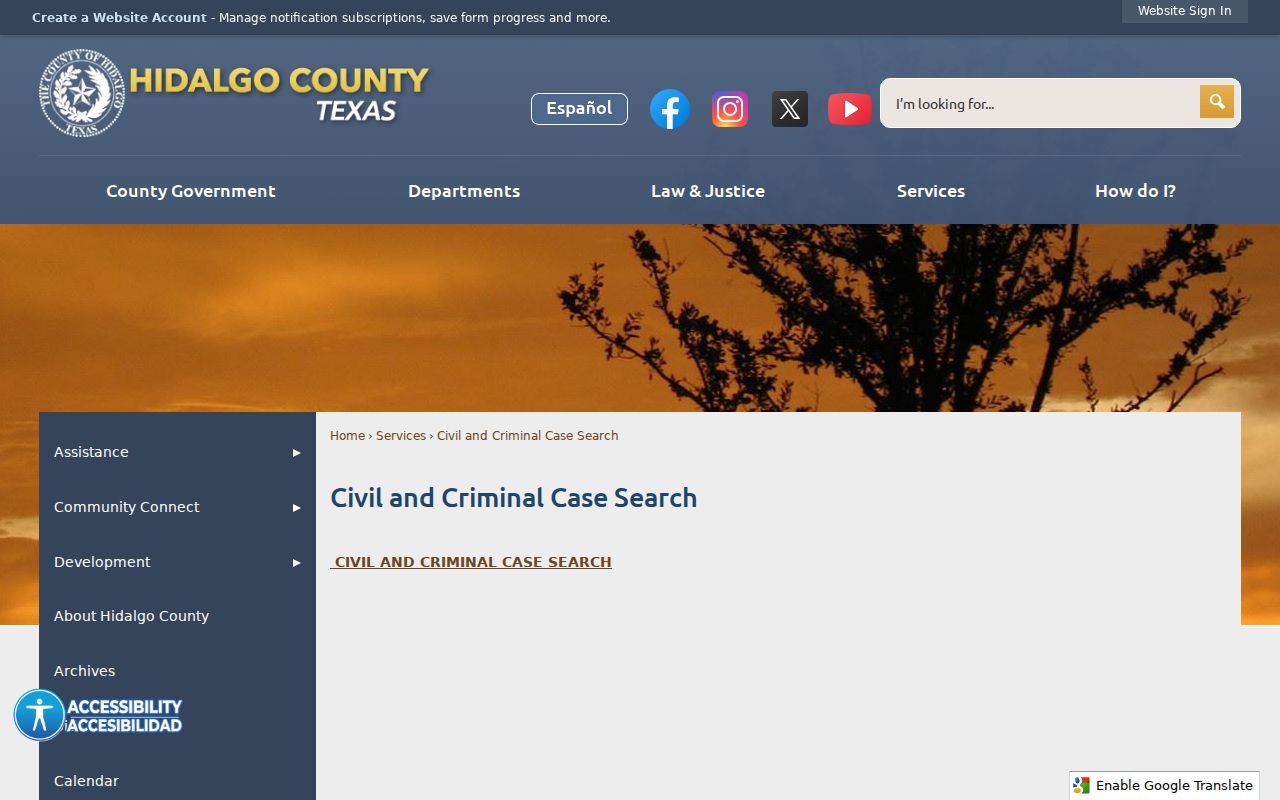
It confirms the county route without implying that every case, document, or result field is available online.
Note: A blank result can reflect spelling, timing, storage, another court, restricted access, or portal coverage rather than a clean record.
Texas Official Background Checks
The Texas Department of Public Safety Crime Records Division maintains the statewide Computerized Criminal History system. Its public name search discloses the conviction and deferred-adjudication information authorized by Government Code section 411.135. It is not a complete fingerprint-confirmed history. DPS warns that names and birth dates do not prove identity, even when the match seems close.
A public online query costs one prepaid $1 credit, including a query that returns no match. The CR-42 mail option costs $10 per subject. A person reviewing their own DPS-held record can use FAST service code 11FT12 through IdentoGO. The published personal-review total is $25, split between the vendor and DPS. Stable storefront locations change, so use the official appointment finder instead of relying on a commercial map listing.
The DPS Criminal History Name Search information page is shown in the assigned image.
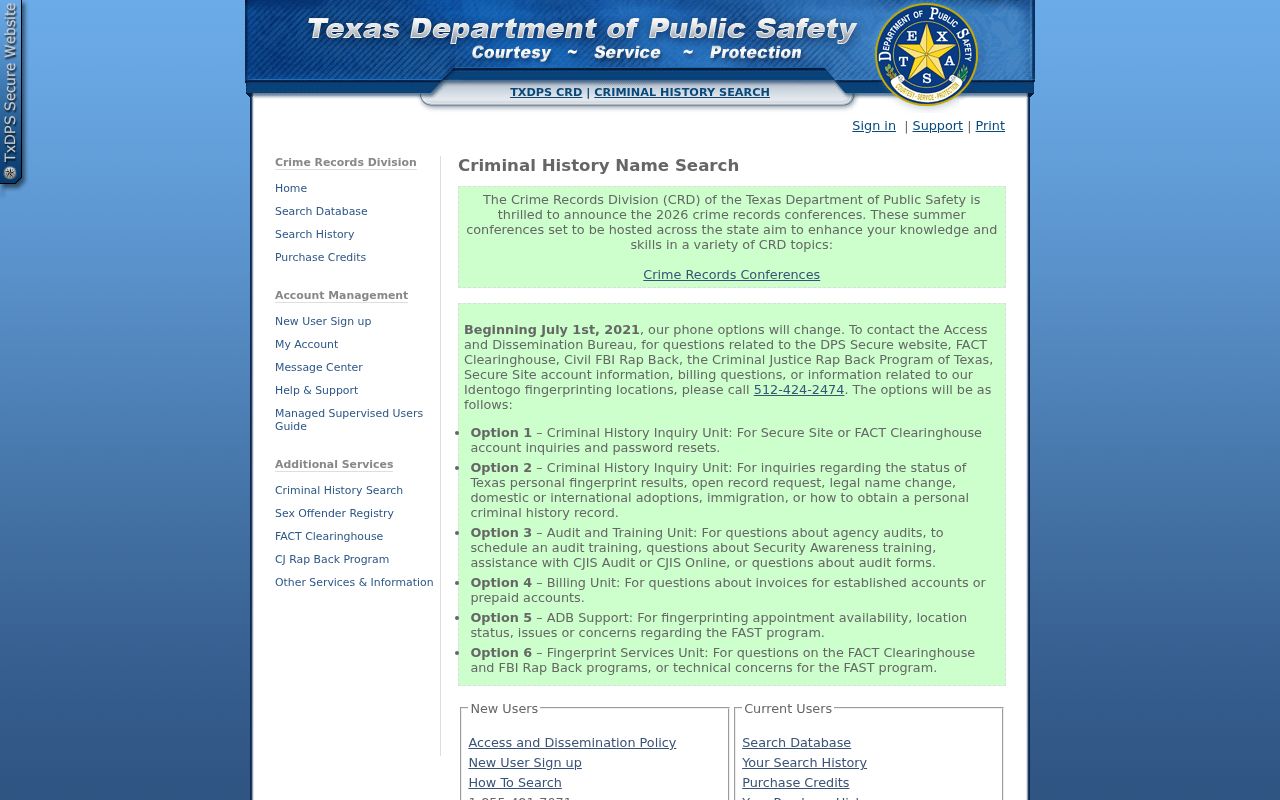
The screen represents the public conviction and deferred product, not a certified identity match or a full Hidalgo County case file.
Hidalgo County Criminal Record Custodians
Hidalgo County uses a clear felony and misdemeanor split. The County Clerk Criminal Department supports County Courts at Law 1, 2, and 4 through 10. It holds Class A and B misdemeanor files, arraignment notices, NISI matters, bond forfeitures, and related paperwork. The District Clerk preserves felony files in the district courts. Municipal and justice courts keep fine-only matters within their own jurisdiction.
The sheriff is the county custodian for bookings, county incident reports, 911 calls, dashcam video, and mugshots. A city police department keeps the report it created. The County and District Clerks share the courthouse at 100 N. Closner Boulevard; their main lines are 956-318-2100 and 956-318-2200. The sheriff is at 711 El Cibolo Road and can be reached at 956-383-8114. Those lines matter because a request for an “arrest record” may mean an officer narrative, jail intake, probable-cause paper, court case, or statewide history.
The official sheriff page provides the source for the next assigned image.
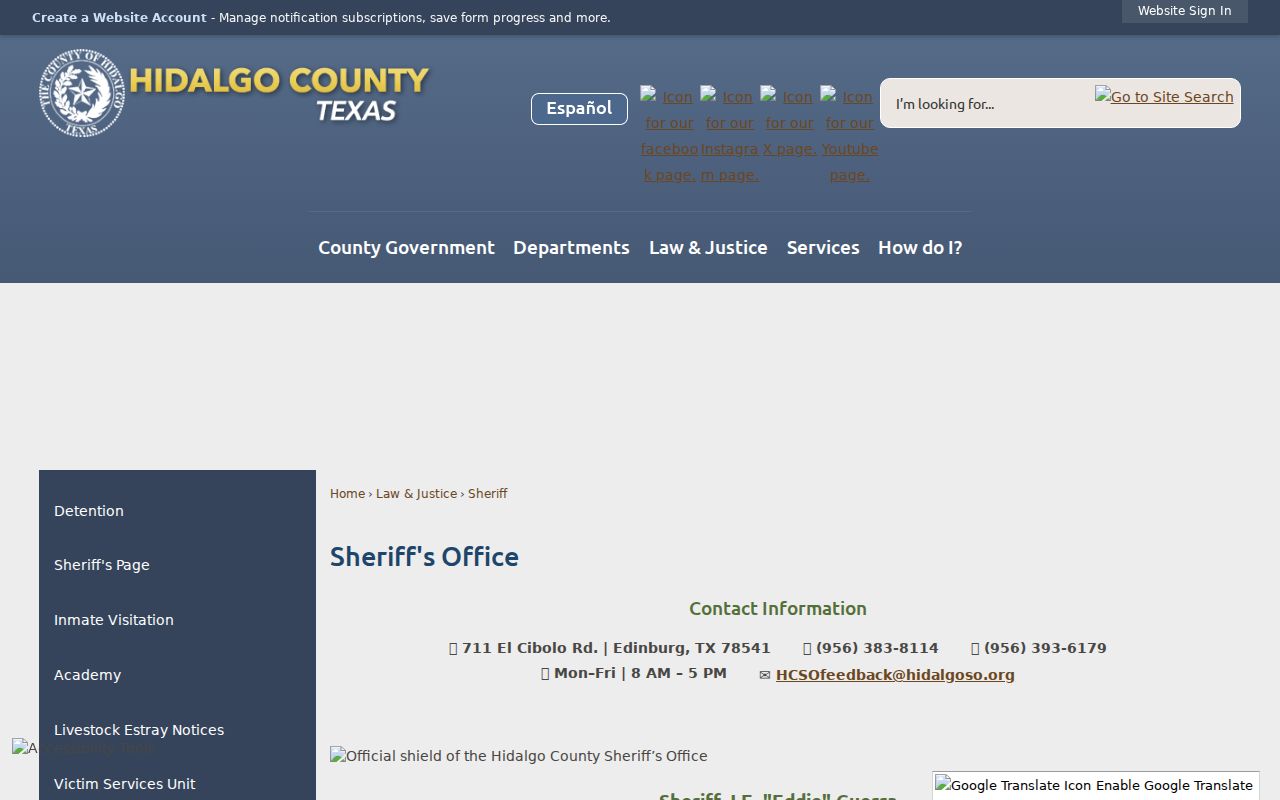
The sheriff's office is the correct county route for law-enforcement and booking material, while final misdemeanor and felony outcomes remain with the clerks.
Criminal Record Types
A criminal record is not a single document. Each Hidalgo County office creates a piece at a different stage. The arresting agency writes the incident or arrest report. A detention facility creates intake and custody material. A prosecutor files a complaint, information, or presents a felony matter to a grand jury. The clerk then maintains the case docket, orders, judgment, and sentence.
- Incident report: the creating police agency's account of the event and allegation.
- Booking record: jail intake and booked-charge information, not a disposition.
- Case file: charging papers, docket events, pleas, orders, and outcome.
- DPS history: reportable fingerprint cycles and reported outcomes, with a narrower public view.
- Custody or supervision record: county jail, TDCJ, federal, probation, or parole status held by the responsible agency.
The correct source can change over time. A recent city arrest may still be in a municipal holding stage. A sentenced person may later appear through TDCJ, while a federal defendant or inmate belongs in the Southern District of Texas or Bureau of Prisons system.
Hidalgo Criminal Records When Searches Fail
When the portal finds nothing, verify spelling and switch to the case number if one is available. Call the County Clerk for a misdemeanor file or the District Clerk for a felony file. Older stored District Clerk records need at least 24 hours for retrieval. A fine-only citation or bench matter may stay with a municipal or justice court and never appear where a felony searcher expects it.
A written request is the next official route for sheriff material. Send a focused description to open.records@co.hidalgo.tx.us or contact the sheriff at El Cibolo Road. Name the existing record, event date, location, case number, and people involved when known. The Texas Public Information Act does not require an office to answer research questions or create a new compilation.
Fallback flow: County portal → responsible clerk or detention office → creating police agency → fingerprint review and DPS Error Resolution when the question concerns one's own statewide record.
Inside a Hidalgo County Criminal Record
The fields depend on the source. A Texas CCH can include identifying data, aliases, a state identification number, and arrest cycles linked by a tracking or control number. Reported prosecutor action, court cause data, disposition, sentence, custody, and supervision events may follow. A court file adds pleadings, hearings, docket entries, and orders. A booking record stays focused on intake and custody.
| Name and identifiers | Names, aliases, birth information, and agency or biometric identifiers where lawfully available. |
|---|---|
| Arrest cycle | Arresting agency, date, alleged offense, and tracking data submitted to DPS. |
| Filed charge | The complaint, information, or indictment may differ from the booked allegation. |
| Disposition | Dismissal, acquittal, conviction, deferred adjudication, or another recorded outcome. |
| Sentence | Custody, fine, restitution, or community-supervision terms stated in the judgment. |
| Status | Custody or supervision information from the agency responsible for that stage. |
Online redactions and exact result fields could not be verified in the live Hidalgo portal. Do not assume that a typical field appears. Get the certified disposition from the responsible clerk when the exact outcome matters.
Hidalgo County Criminal Custody Records
County jail, state prison, and federal custody are separate layers. The Hidalgo Adult Detention line is 956-381-7900. For very recent city custody, Mission operates a 24-hour detention center and Edinburg publishes a city jail line. After transfer or sentencing, the right source may change. Absence from one roster does not prove release or the absence of a case.
The TDCJ Online Inmate Search is the official state-prison locator assigned to the next image.
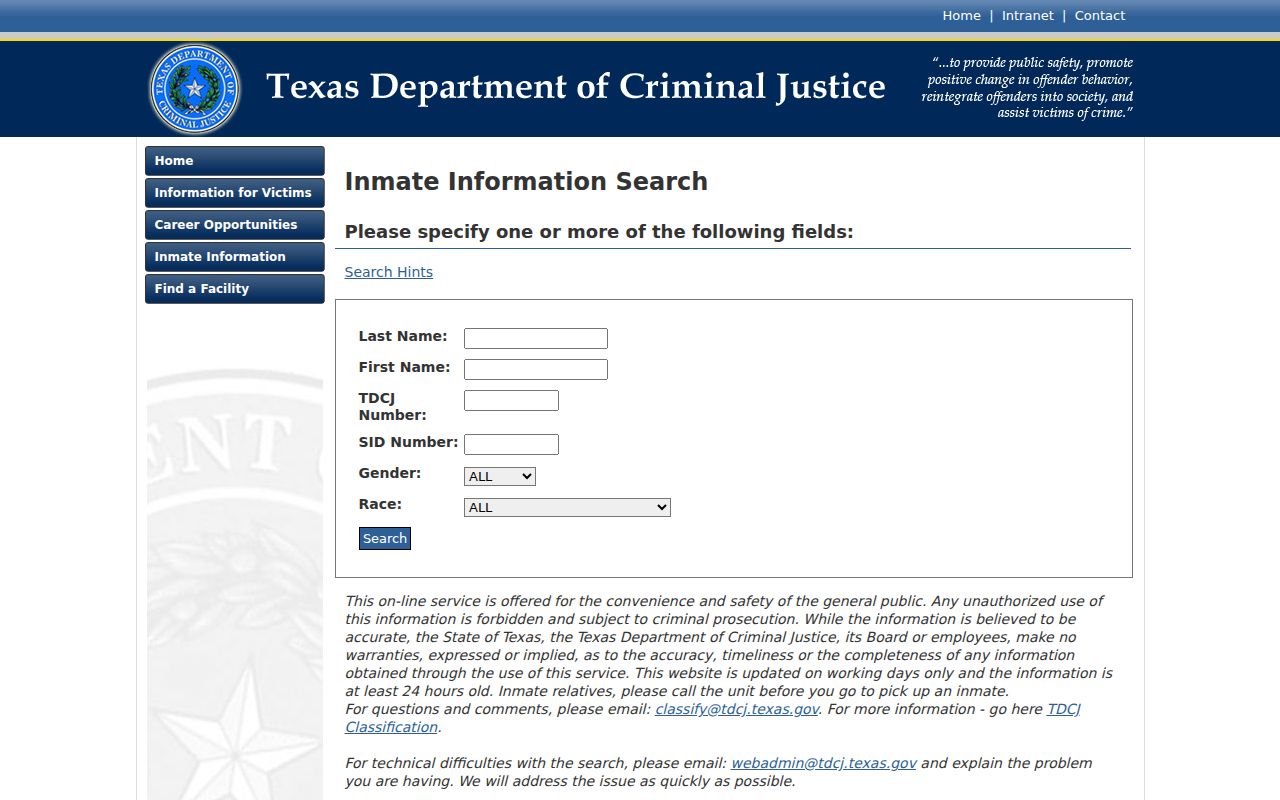
TDCJ covers state custody and parole information, not a new Hidalgo County booking or a municipal holding cell.
Federal custody uses a different channel. The Bureau of Prisons inmate locator covers federal inmates from 1982 forward.
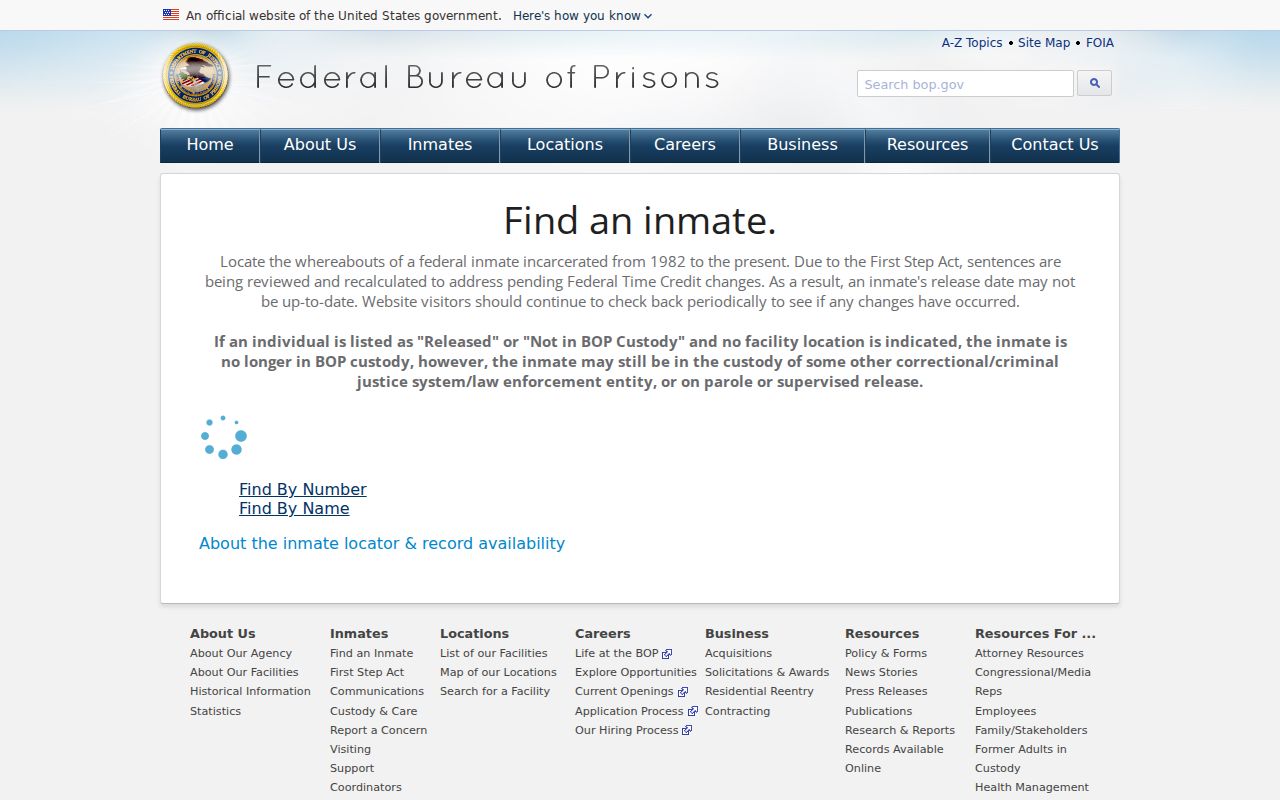
A federal result reports federal location or release data; it does not replace Hidalgo detention, TDCJ, or the federal court docket.
Public Access Laws in Texas
Texas law opens some records and restricts others. The practical rule is to ask the actual custodian for an existing record. Investigative material may fall within a withholding exception, while basic arrested-person, arrest, and crime information remains subject to Government Code section 552.108(c). DPS criminal history is confidential except where another law authorizes release, including the public conviction and deferred product.
Key statutes:
Government Code Chapter 552 governs written public-information requests and law-enforcement exceptions.
Government Code Chapter 411 controls DPS criminal-history access and nondisclosure.
Code of Criminal Procedure Chapter 66 establishes reporting duties that build the statewide history.
Code of Criminal Procedure Chapter 55A governs qualifying expunction cases.
Code of Criminal Procedure Chapter 62 governs sex-offender registration and public fields.
Subject access can be broader than public access under section 552.023. Juvenile information, victim identity, sensitive identifiers, active work product, sealed material, and grand-jury proceedings can remain restricted.
Hidalgo County Criminal Record Terms
Local files use short terms that describe a stage, not the whole case. Reading them in context prevents a common error: treating an allegation or interim entry as the final judgment. Hidalgo County Clerk records can also include NISI and bond-forfeiture matters that are easy to mistake for a new finding of guilt.
- Information
- A prosecutor-filed charging instrument commonly used for a misdemeanor.
- Indictment
- A grand jury's true-bill charging instrument for a felony.
- Disposition
- The recorded outcome or status that resolves a charge.
- Deferred adjudication
- Supervision imposed while the court defers a finding of guilt; it appears in the DPS public product.
- NISI
- An initial bond-forfeiture judgment after a failure to appear.
- Capias
- Court process directing that a person be taken into custody.
Always compare the booked charge, filed charge, and final disposition. They can change at separate points in the same Hidalgo criminal record trail.
Sealed, Expunged, and Restricted Records
Texas expunction and nondisclosure are different forms of relief. Chapter 55A expunction is the stronger remedy and applies only to statutory categories, such as qualifying acquittals, pardons, no-bills, and some dismissals after all conditions are met. An order directs named agencies to remove, destroy, or return covered records as the law provides. A dismissal by itself does not erase an arrest trail.
A nondisclosure order under Government Code Chapter 411, Subchapter E-1 restricts public dissemination in eligible cases, but specified criminal-justice and government entities may retain access. Eligibility, waiting periods, excluded offenses, and filing routes turn on the exact charge and outcome. Start with a certified disposition, identify each agency that holds a record, and use the court with jurisdiction over the matter. Hidalgo County publishes an expunction information page, but the current local filing fee was not confirmed in the research.
After an order, a person can use a DPS fingerprint review and county search to check implementation. If the record remains, send the certified order and disposition to the reporting agency and DPS Error Resolution.
Hidalgo County Criminal Record Supervision
Community supervision is Texas's term for court-ordered probation. Hidalgo County CSCD maintains local supervision records and offers named programs that include Drug Court, DWI Court, Veterans Court, mentally impaired and sex-offender specialized caseloads, SAFPF aftercare, substance-abuse treatment, domestic violence services, and alternative incarceration. There is no public Hidalgo probationer database. A court sentence and the CSCD are the proper starting points.
The Hidalgo County Adult Probation page supplies the assigned view of these local programs.
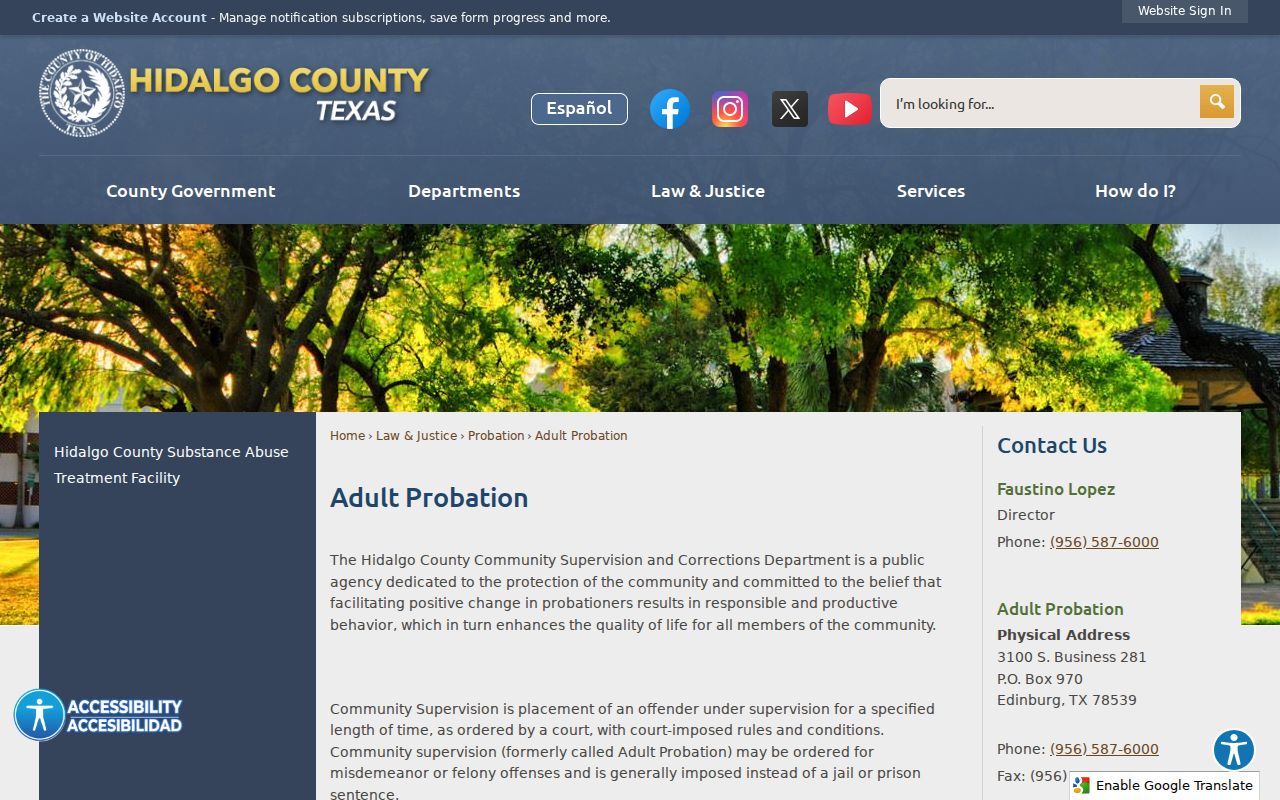
The program list adds local context, but supervision officer files and detailed conditions are not presented as a public search product.
Parole is separate. The Texas Board of Pardons and Paroles makes release and revocation decisions, while the TDCJ Parole Division supervises releasees. The McAllen District Parole Office serves Hidalgo and Starr counties. A court judgment, TDCJ locator, or official status line can help trace that stage.
Hidalgo County Criminal Records by City
McAllen, Edinburg, and Mission are Hidalgo County's three largest incorporated cities in the research ranking. Each police department owns the report it creates, and each municipal court keeps city citations and fine-only matters. Their local channels add detail that a county case or jail search may not show.
McAllen Criminal Records
2025 estimate: 150,640. Police and municipal court requests use separate forms.
Edinburg Criminal Records
2020 Census: 100,243. EPD Records accepts GovQA, counter, and mail requests.
Mission Criminal Records
2020 Census: 85,778. A 24-hour city detention center can be the first custody stop.
Higher-level cases still route to the Hidalgo County Clerk or District Clerk, and county custody routes to the sheriff after transfer.
Hidalgo County Criminal Record Fees
Verified prices differ by product. County sheriff report, certified criminal-copy, and expunction filing amounts were not located in official sources, so request a current estimate from the custodian. Published state and federal charges are more definite.
| Product | Verified amount |
|---|---|
| DPS online conviction or deferred query | $1 credit, charged even without a match |
| DPS CR-42 mail search | $10 per person |
| DPS FAST personal review | $25 total |
| FBI Identity History Summary | $18 |
| PACER federal records | $0.10 per page under the current schedule |
Credit-card purchases for DPS search credits add a published percentage and transaction charge. PACER waives an invoice when quarterly charges stay at or below its current threshold, and many single documents have a cap.